> For the complete documentation index, see [llms.txt](https://manuals.dialox.ai/llms.txt). Markdown versions of documentation pages are available by appending `.md` to page URLs; this page is available as [Markdown](https://manuals.dialox.ai/studio/flows/nodes/dial-smart.md).
# Dial: Smart
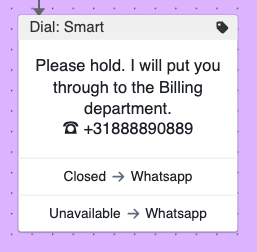
To create a smarter experience, the **Dial: Smart** node extends the regular **Dial: Number** node with fallback capabilities. This saves you creating additional Flow steps and branching.
If the conversation happens within opening hours, the system will announce the forward and dial the number to forward the call according to the provided details (number and SIP method).
If the conversation happens outside opening hours, the system will provide a closed message and fall back to a specified Flow.
The same thing happens if the dial fails for any reason (usually because the receiving party is unavailable). When you use a Flow for the called party, this includes the called party declining the call.
Dialing can be done in two different ways:
* SIP invite (the call is handed over, but if it fails, it returns)
* SIP refer (the call is immediately handed over and will not return)
**Check extension availability**
When the **Check extension availability** setting is switched on, we will check whether there are human operators available to accept the incoming call. This check varies per extension type.
Disable this setting if you want to forward the call regardless of the status of the destination (e.g., when you have fallback settings configured on the call queue itself).
Extension type
Call will be forwarded to destination
Queue
If there are agents logged in to the queue
Group
If there are members in the group
User
If the user is available (not busy or on another call)
Other extension types
Will always forward the call
{% hint style="info" %}
This feature is only enabled on the Grid telephony adapter.
{% endhint %}
**Properties**
| Property | Description | Explanation |
| ---------------------------- | ---------------------------------------------------------------------------- | --------------------------------------------------------------------------------------------------------------------------------------------------------------------------------------------------------------------------------------------------------------------------------------------------------- |
| destination | The destination type for the call (default) | "Default" to dial the following number in any situation. "Contact based alternatives" to dial a number that is based on user data (a specific contact field). See Dial: Number for more information about the different destination options. |
| Number | The number to call | Using the extension checkbox, a non-ISO phone number can be provided. This way extension numbers are valid to enter. |
| SIP | The method for dialing | See above. |
| Caller ID | Which number is presented to the called party | "caller" or "bot", defaults to "caller". Only works for SIP invite. See Dial: Number for details. |
| Timeout | Timeout in seconds | Only works for SIP invite. Stops counting once the Flow for the called party has started. |
| Flow for the called party | The Flow that runs for the person being called, before the call is connected | Only works for SIP invite. See Announce the call to the called party. |
| Handover message | Text that is passed on to the Flow for the called party | Only used together with a Flow for the called party. Supports variables and translations. Available in the called party's Flow as the variable `handover_message`. See Announce the call to the called party. |
| Text | Announce the forward | |
| Check extension availability | Whether to check if the extension has human operators available | See Check extension availability. |
| Opening hours | Specify how the opening hours are determined |
Options:
from settings
from timeplan
custom
Notice that you need the skill Timeplans to be installed to use the "from timeplan" option.
|
| **Closed situation:** | | |
| Text | The message to provide if closed | |
| Flow | The Flow to jump to if closed | |
| **Unavailable situation:** | | |
| Text | The message to provide if unavailable | |
| Flow | The Flow to jump to if unavailable | |
**Caller ID**
*Caller ID selection only applies to SIP invite dials; with SIP refer the network handling the handover determines the presented number.*
**caller** (default): the original caller's number is presented, so the called party sees who is actually trying to reach them.\
**bot**: the Bot's own number is presented instead — useful when the caller's number shouldn't be exposed, or when the receiving system only accepts calls from a known (whitelisted) number.
{% hint style="info" %}
Be aware that this node will redetermine the `online` and `offline` tags based on the optional custom time plan provided. This way, logic executed after this node might be impacted by it.
{% endhint %}
**Announce the call to the called party**
With SIP invite you can run a short Flow for the person you are calling *before* the call is connected, for example to tell them who is calling and let them accept or decline the call. Select the Flow in **Flow for the called party** and, optionally, add a **Handover message** with information for the called party.
The Flow for the called party, the Handover message and the Dial: Bridge call and Dial: Cancel bridge nodes work exactly as described for Dial: Number. The differences for Dial: Smart:
* The opening hours and the extension availability are checked first. The Flow for the called party only starts when the call is actually dialed, after the **Text** that announces the forward has been said to the caller.
* If the called party declines the call (the Flow ends in **Dial: Cancel bridge**), or their line ends before the call is connected, the **Unavailable situation** applies: the unavailable **Text** is said and the unavailable **Flow** is started.
* If the call was connected, the conversation closes once the call has ended. The closed and unavailable Flows are not started.
{% hint style="warning" %}
A Flow for the called party is only available on the Grid telephony adapter, and only for user extensions and external numbers. It is not supported for queues and groups; use SIP refer for those.
{% endhint %}
### Resources
* Phone flows
* Dial: Number
* App Settings